

Spring Valley EDA News
Young entrepreneurs to showcase creations in SV
Original article published in the Mower County Independent, Thursday, July 23, 2026. Reprinted with permission and gratitude.
By David Phillips
While many kids 14 and under might be spending their summer at the pool, playing video games, or scrolling through their phones, some are dis covering a fun and productive way to spend their time—starting their own businesses!
The entrepreneurial ventures of several local youth will be showcased next month at the Spring Valley Minnesota Children’s Business Fair, which is scheduled for Saturday, Aug. 8, from 9 a.m. to noon at Bluff Brothers Brewing in Spring Valley. The public is welcome to view the young entrepreneurs’ creations and purchase their items during this free event.
It might not seem like there would be many entrepreneurs aged 6 to 14, but organizer Jordan Li effort has already signed up over 20 young people for booths. Each child will have his or her own booth to showcase and sell products.
Lieffort, who has lived in Spring Valley since 2019 and is a stay-at-home mom with three children, came up with the idea after attending a similar event in another city with her daughter. They had such a great time that she decided to create one in Spring Valley to give local kids a chance to shine.
“I honestly never expected it to take off the way it has, and I’m incredibly thankful for the support we’ve received from our community,” she said. “I’m excited to see our community come together to support these amazing young entrepreneurs, and I hope this becomes a tradition that continues to grow for years to come.”
Some examples of products from the youth who are signed up include dirty sodas, homemade jewelry and natural lip balm. Lieffort added that many kids already create something, so whether it’s crocheted pot holders, beaded jewelry, painted vases with greenery, or something else, they just need a little help to find a market.
Lieffort shared that her mom always told her kids, “If you want to do something, you can do it,” a mantra that’s stayed with her. Now, as an adult, she’s a go-getter herself and teaches her kids the same idea: if they want something, they can make it happen.
For the business fair, the young entrepreneurs can whip up anything they dream up, even using things they already have at home. They don’t have to spend a fortune to create something because the learning is what really matters.
“The Children’s Business Fair gives young entrepreneurs the opportunity to create their own business, develop a product or serv ice, and present it to the public. It’s an exciting hands-on experience that teaches responsibility, creativity, problem solving, customer service and what it takes to run a business,” she explained. “These children are our future, and it’s inspiring to watch them build confidence while sharing something they’ve worked hard to create.”
The event is completely supported by kind local sponsors, so there’s no booth fee for the kids to participate. Every penny raised goes straight back to the kids through cash prizes, and any extra money will be used to make next year’s event even more exciting and fun, according to Lieffort.
The youth will be on their own at the fair, though the youngest kids might get a little help from a parent or guardian if they’re not comfort able counting money. There’s no help from the local business sponsors, and most of the time, the parents are asked to step back and explore other booths to see what other kids have created.
During the event, shoppers and other participants will vote for their favorite booths. These votes will be counted, and the first-, second-, and third-place winners in each age group will receive cash prizes. The event will wrap up with an awards ceremony from noon to 1 p.m., where the winners will be recognized and presented with their cash prizes.
Lieffort discovered the participants for the fair through a Facebook page called Spring Valley MN Children’s Business Fair. So far, more than 20 young people have signed up, with some even coming from Austin, Dodge Center, and Preston. If you’re still interested in setting up a booth, you can sign up on the Facebook page up to a week before the fair.
“I was really surprised by how popular it became,” she mentioned. “I thought we’d only have about seven participants, but we’ve now got over 20 different booths.
Courtesy of the Mower County Independent, 135 E Main St. LeRoy, MN 55951, (507)-324-5325
Spring Valley Public Library awaiting new façade
Original article published in the Mower County Independent, Thursday, June 25, 2026. Reprinted with permission and gratitude.
By Gretchen Mensink Lovejoy
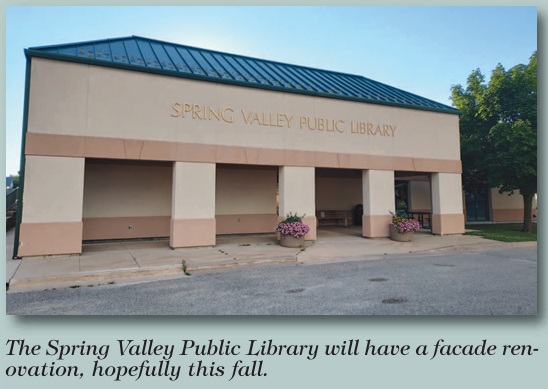 They’ve been scheming.
Just wait until the work’s done…
“I’ve been meeting with the construction committee to discuss the color scheme,” said Bolton & Menk engineer Philip Bussey as members of the Spring Valley Public Library’s (SVPL) construction committee gathered with the Spring Valley Library Board of Trustees on June 25 to review with Bussey the plans for the library’s new façade and patio, a process that has been underway for the past several months after the library received a state library construction grant to upgrade SVPL’s exterior covering because the former SuperValu grocery store has been in service as a library for nearly a quarter century.
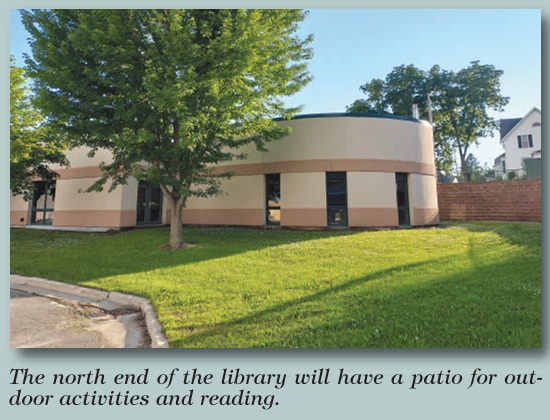
The long-awaited project has been on the trustees’ list of improvements for the past several years due to the exterior, EIFS, or external insulated finishing system, having weathered the weather itself, along with impacts from snowblowers and lawnmowers and young bicyclists who overlook that their handlebars cause damage to the structure. Furthermore, the north end of the library has unused outdoor space that is to be converted into a patio accessible by a door from the collections room. The board and administration had applied for a matching grant from the state to help underwrite the costs, and in March, they were pleased to hold the official paperwork for the grant’s funding.
The construction committee has convened and brought its determinations to the library board for further consideration throughout the beginning of the year and into the summer. Also, trustees and library director Melissa Vander Plas had passed samples of exterior finishing materials around the table during previous library board meetings to gather input on what color scheme and configuration might look best to make patrons and visitors confident that the place they are entering is indeed a community center for learning and entertainment. During the most recent board meeting, Bussey showed the trustees a concept drawing of the library clad in gray stonework and stucco-like material, with the faux stone wrapped all the way around the ends of the building to provide greater protection to the corners. He highlighted for the members what the patio could look like as well, and he took suggestions and traded items out of and into the concept drawings as the board asked questions.
He outlined that “the next phase is bidding and the actual construction process” once the board is satisfied with its and the construction committee’s choices. Bussey delineated, “This project is above the threshold…it requires a public bidding process.” The board was to approve the bidding process, then the bids will be brought to the city council, with hopes that the project’s parts can be awarded and construction begins early this fall for a refreshed start in the new year. Vander Plas expressed optimism in the bidding timeline and her excitement at the impending construction that will transform the library’s front entrance and yard into a place that welcomes the community to come in and find a book or settle in for a chat in the sunshine.
 SVPL’s staff is currently busy with the children’s summer reading program, but once that is finished at the end of July, there will be room for the paint contractor to complete the ongoing interior painting project as well – a cozy yet cool blue-gray replaced the beige-white that has been the backdrop for library activities since the grocery store’s conversion to a library. No matter what structural improvements are underway, readers of all ages can enjoy a good read at their library.
The Spring Valley Public Library, at 121 W. Jefferson St., is open Monday from 10:00 a.m. to 6:00 p.m., Tuesday through Thursday from noon to 7:00 p.m., Friday from 10:00 a.m. to 5:00 p.m., and every Saturday from 10:00 a.m. to 2:00 p.m. For more information, log onto the library’s Facebook page or website, stop in, or call 507-346-2100.
Courtesy of the Mower County Independent, 135 E Main St. LeRoy, MN 55951, (507)-324-5325
Kiwanis Club of Spring Valley seeks nominations for Citizen of the Year.

The Kiwanis Club of Spring Valley is asking the community to nominate an outstanding person to be honored at its’ annual Citizen-of-the-Year program to be held in the fall.
The Kiwanis Citizen-of-the-Year is chosen by the club from nominations received from the public. Forms can be picked up at Spring Valley City Hall or the Spring Valley Public Library, or downloaded/printed below, and must be returned to them or mailed to the Kiwanis Club of Spring Valley, P.O. Box 133, Spring Valley, MN 55975, by September 1, to be considered for this years’ nominee.
Any monies given to acknowledge the Citizen-of-the-Year selected will be deposited into the Kiwanis Clubs’ Citizen-of-the-Year scholarship fund.
CLICK HERE TO VIEW AND PRINT THE APPLICATION
Ag Days 6k returns on Saturday, August 22, 2026
Registration is now open for the annual Ag Days 6k run on the paved Spring Valley trail.
Runners start on County Road 8 near the camper parking area east of Spring Valley. They take a turn into the camping area after a short distance and then follow the trail all the way to Willow Park near the pavilion. The 6k race is about 3.72 miles long.
Runners will meet from 7 to 7:40 a.m. on Saturday, August 22, at Willow Park, which is located just east of downtown, for the 8 a.m. race. Runners will board a bus at 7:45 a.m. for a shuttle to the camper parking area on County Road 8. The scenic trail has no intersections with public roads as it crosses over Spring Valley Creek several times and underneath Highway 16. There will be an aid station along the course plus refreshments at the end.
Register for the Ag Days 6k run is online below with no added fees. Forms may also be picked up at City Hall.
Race day registration begins at 7 a.m., but runners are encouraged to register in advance.
- The price for the 6k race is $25 for runners signing up prior to August 2.
- The price is $30 from August 3 to the day of the race.
- The first 50 people registering for the race will get a custom performance T-shirt.
Trophies will be awarded to the overall male and female winners in the 6K race as well as for the top three males and females in age groups.
For more information on either event, contact Dave Phillips at 507-346-2368.
Click Here to Register for the Ag Days 6K
The annual 1k free kids run, called the Little Husker, will also take place on Saturday, Aug. 22, at 9:30 a.m. The race, sponsored by the Spring Valley Area Community Foundation, is free of charge. The routes for various ages are on the trail at Willow Park.
For information, visit The Little Huskers 1k Free Kids Run page.
Students go underground to energize their creativity
Original article published in the Mower County Independent, Thursday, June 25, 2026. Reprinted with permission and gratitude.
By David Phillips
Some Kingsland students found their creative spark while exploring the depths below the surface.
In May, students in Valarie McConnell’s art class ventured underground during a tour of Mystery Cave at Forestville/Mystery Cave State Park, southeast of Spring Valley, to find inspiration for their artwork to wrap up the school year. The cave’s passages, pools and rock formations became the foundation for their creations, which are now on display at the cave visitors center.
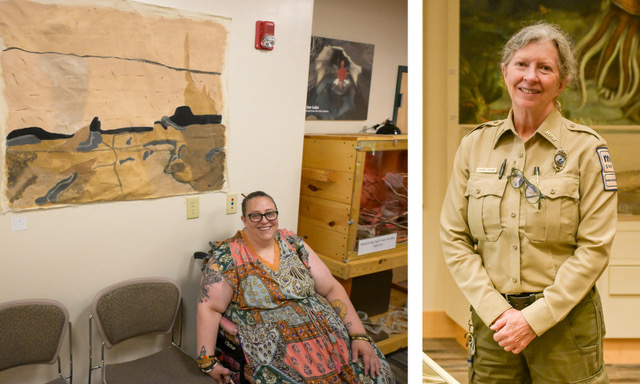
The idea came from Dawn Ryan, who oversees Mystery Cave. She used to work at a national park with an artist-in-residence program that visitors loved. Mystery Cave doesn’t have the budget for that, but she thought it would be a fantastic idea to invite art students from Kingsland, the closest school to the cave, to create art inspired by it.
“I’m a big fan of art in parks,” she said. “I really believe art and nature go hand in hand.”
McConnell was so excited about the idea that she took the students on a field trip in May. Many of them snapped photos to help guide their projects. The gallery opening was on Saturday, June 13, with many of the students on hand to chat with cave visitors about their art.
The student artwork showcased a wide range of techniques, from pencil on paper to abstract acrylic on canvas.
Elissa Schneider started the process for her acrylic on canvas project when she discovered a section of the cave that really grabbed her attention. At first glance, this small part of the cave seemed unimportant, she said, but when she looked closely, she found an incredible amount of detail and texture, so she wanted to capture that amazing beauty and complexity.
“One of the most important artistic choices I made was deciding to paint the entire piece using only shades of purple. Part of the reason was that I had often heard that painting with only purple is extremely hard to do because it can be hard to create depth and variation without introducing other colors. I wanted to challenge myself creatively,” she said.
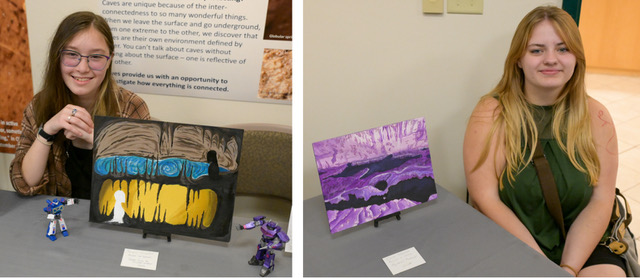
“The other reason was inspired by the cave tour itself. The guide used both a regular white flashlight and a purple blacklight while showing us different features of the cave. The blacklight revealed glowing bacteria and highlighted details that were invisible under normal light. I wanted my painting to reflect that experience and show that there is often more than one way to see and understand a place.”
Carter Gilbert was drawn to a smooth area of the cave, a striking contrast to the jagged rocks and edges everywhere else. He used pencil on paper for his piece, called “Below,” because it shows what’s underneath when people are walking on top.
“The stalactites, flowing down, were all smooth because of the water dripping over time,” he explained. “I thought it looked really nice.”
Maddie Horton also used pencil on paper for her artwork, called “Darkness of the Cave.” She took lots of photos but picked one that showed a dark tunnel.
“I liked it because of how it was kind of like the structure of the cave. It’s not showing exactly what it looked like, of course, but there’s just definitely a lot of different rocks around and I don’t really know how to explain it. It was just going into somewhere kind of like an abyss or a void or something like that,” she said. “So I like the mystery of where it was going.”
Emily Sargent used acrylic on canvas for her project called “Into the Desolate Depths,” which is actually quite colorful. Her scene is near the beginning of the tour and includes a walking bridge over a water pool.
She said she was attracted to this scene because it has “a bit of everything seen in the cave, like some of the water pools, all the limestone,” and even the stalactites.
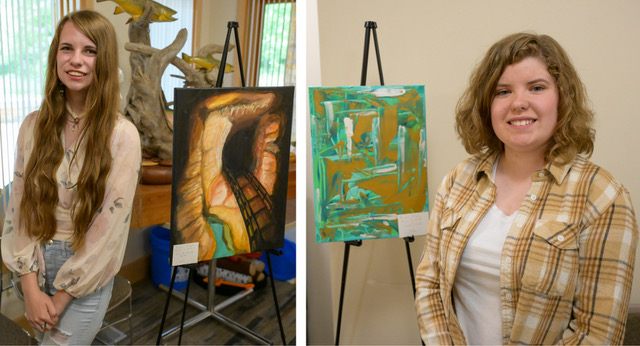
Reyna Campbell also explored acrylic on canvas with “Golden Cave to Crystal Waters.” Her inspiration came from two cave sections: one with a cave lake featuring light blue, teal, and brown hues, where a friend posed, and another with a lot of yellow lighting streaming through a large, round, black tunnel.
“It really gave me like a good idea on how really expansive this cave is, and the variety of all the different places inside the cave really inspired me,” she said. “I had a lot of fun with this piece.”
Brynn Fussy also used acrylic on canvas, but her piece, “Golden Waters,” is more abstract. She spread paint around, using a palette knife to smear it for an abstract effect.
“In the cave, we ended our little tour with this really cool pool of water. The gold comes from the really pretty reflection of gold that you get at the bottom of the pool,” she said. “And then the greens, the blues, and the dark blues come from the reflection from the top of the water, which I thought was really cool. The shimmering white also represents the dripstone in the cave that you get from the ceilings in the cave.
“So I kind of wanted to just represent the beauty of that pool, which I thought was really cool.”
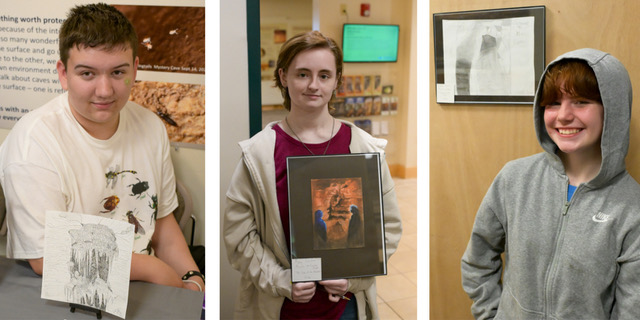
Abigail Carlson took a bold step by trying watercolor for the second time ever in her piece called “The Eyes of the Beholders.” She enjoyed how the red values showed up in a rock formation with stalagmites and stalactites, but when she took a photo for reference, two of her classmates were accidentally included. However, she liked the lighting on them, so she included them in her painting.
“The blue of the figures contrasts very nicely with the nice red and orange tones of the rock formation. I really liked all the depth and composition of just the two figures looking at it,” she said.
McConnell also contributed to the gallery with the largest piece on display. Her acrylic on cotton is based on a spot in the cave that looked like a desert scene. “I thought it was really cool that you could find a desert in a cave,” she said.
“Mine is called Stone Remembers because stone is kind of like water and it has memory. And it just kind of fit because maybe once upon a time there was a desert,” she said.
The Kingsland instructor mentioned that Ryan’s request came out of the blue, but she loved the idea, which was great for her class, so she hopes to make this an annual trip with a bigger group next year.
The students also found it beneficial. For example, Campbell explained, “I have not really had the time or the determination, I suppose, to find a place and be like, ‘I want to paint here and take inspiration from here.’ So this was kind of a first for me. But it was a really fun experience, and I hope I get to do it sometime again because it was a good learning experience.”
Schneider said she really enjoyed the project because it gave her the opportunity to “spend time with a group of amazing people, all of whom had great personalities and made the experience enjoyable.” She also appreciated the quiet time painting, as it was calming to focus on one aspect of the artwork.
“I really appreciate them coming,” said Ryan. “It brings some added value to the visitor center, to the visitors. They like to see changing exhibits as well.”
Courtesy of the Mower County Independent, 135 E Main St. LeRoy, MN 55951, (507)-324-5325


