• Skip to main content
  • Skip to footer

Spring Valley EDA

Tools for Economic Growth in Spring Valley, Minnesota.

  • Business
    Listings & Tools
  • Business Real Estate
    Sale, Lease, Rent
  • Move
    to Spring Valley
  • Build
    in Spring Valley
  • Zoning
    & Permits
  • City
    of Spring Valley
  • Community
    Calendar
  • About
    Spring Valley
  • Contact

Spring Valley EDA News

The long, arduous road to American identity

03/13/2026 by Chris Hahn

Original article published in the Mower County Independent, Thursday, March 5, 2026.   Reprinted with permission and gratitude.

By David Phillips 

A Lunch and Learn program at Good Earth Village on Feb. 24 about abolitionists and the Underground Railroad in the area led to thoughts about what it means to be an American, even today.

At the start of the lunch program, which is the first in a series, presenter Sara Holger talked about her family history, which turned out to be completely different than she was led to believe as a child since she later found she actually isn’t Scandinavian and her family includes some enslavers, although she is still holding out hope that it also includes an abolitionist.

I didn’t learn about my family history until I was older, so I had no illusions as a youngster, but it turns out my family is about as American as possible with both sides traveling from England to this continent prior to the 1630s. The Phillips side of my family started here with the Rev. George Phillips, a Puritan minister who formed a Congregational church in 1630 in what became Watertown, Mass., just outside of Boston.

Puritans, who fled persecution in England, greatly influenced American culture with its emphasis on religion, literacy, work and civics. Their descendants, along with others from early Euro pean settlers, made up most of the Founding Fathers of the United States.

With that kind of family history, how could I not be a true American? However, as Holger’s talk showed, history can be more complex.

In reality, these early settlers were immigrants, keeping most of their existing European traditions, language and Christianity, instead of assimilating with the people already living here, Native Americans, who had their own religions, languages and customs.

Also muddling the historical picture is that around the same time my ancestors came here, the first African slaves were brought to the continent. With such a lengthy history in this country, their descendants should be considered as American as I am, yet that often isn’t the case. One detriment is that these descendants don’t know their family history. Slaves were prohibited, even by law in the early 1800s in southern states, from reading or writing, plus families were often torn apart, and surnames weren’t often used, making it challenging to trace their ancestry.

Although descendants of these Africans lived in America for centuries, just as my European an cestors did, it took them more than 200 years to gain their freedom after the Civil War and another century to gain full rights as true Americans because Jim Crow laws in the South, which existed as late as the 1960s, sanctioned segregation and second-class citizenship for African-Americans.

Not everyone, though, thought that these Americans should have to wait to be included in all that our country has to offer. In the 1800s, abolitionists rose to prominence. One of the most famous ones is Wendell Phillips, who is also a descendant of the Rev. George Phillips. I’ve seen his statue in Boston and read his biography since he shares lineage with me.

Holger’s talk highlighted that there were also abolitionists in Minnesota, many who moved here before Minnesota became a state in 1858. The territory was in the free part of the Union, but Southerners and some military officers were bringing slaves to the state and getting away with it because there was no specific law prohibiting it.

Abolitionists here wanted to make sure that when Minnesota became a state, its Constitution prohibited slavery. Among them was James Michener, who lived between Cherry Grove and Etna. He was raised a Quaker in Ohio and spent his adult life in Indiana before moving in 1857 to southeast ern Minnesota, where he farmed, growing apples.

Not a lot is known about Michener’s specific abolitionist activities. There is evidence of gatherings and other activity, but the lives of abolitionists were secretive because this wasn’t always looked on as a true American activity.

“They weren’t main stream. We’re talking about a small percentage of the population at the time that were abolitionists,” said Holger. “They were mobbed, beaten, murdered, thrown in jail. It was a risky thing to put yourself out there and say you were an abolitionist.”

While it might be surprising that slaves briefly lived in Minnesota at one time, Holger also found it surprising that there were many other Black or multiracial people in the state before the Civil War. The new territory had many transient people, leading to a more diverse population than expected.

Many of the stories are just being uncovered as more newspapers and archives become digitized. Research by Sara Sturgis, former director of the Fillmore County Historical Society, found many Black settlers in our area, but most don’t have headstones in local cemeteries.

Holger noted an example of African-Americans and multiracial people that lived in Hart, just north of Rushford. Joseph D. Jeffrey, who was elected overseer of the poor there, is one of the earliest documented persons of color to hold a political office in Minnesota. It’s uncertain why the families came to the area, but speculation is that it was through local abolitionists aiding in the Underground Railroad.

Although abolitionism is relegated to history, it seems that it should be a timely subject as there is an effort to erase references to slavery at federal historical sites and in school textbooks in certain states. There is a push to honor our European history while looking past the contradictions that in volve other types of Americans.

Vigorous debate also remains about who gets to be called an American today. The flashpoint now is immigrants.

Most of the debate is on illegal immigration, where one side labels people they call agitators as un-American because they coddle criminals and impede federal law enforcement, while the other side feels that some immigrants who are going through the proper process for citizenship and even American citizens are getting caught up in a campaign that uses un-American tactics, such as agents bursting into homes, guns drawn, without judicial warrants, or enforcers stopping random people on the streets just because of their complexion or accent.

The rhetoric has spilled over to accusations that even legal immigrants and their descendants from certain countries, Somalia for example, aren’t true Americans.

How this issue plays out remains to be seen, but tomorrow’s historical records may well show these more recent contradictions may be resolved in a surprising outcome that doesn’t necessarily align with those in power.

As Holger noted, one reason abolitionism is a fascinating subject is because “it shows that just a small group of people really did change the world.”

For more information on Holger’s project, she suggests using Google to search for “abolitionists of Southeast Minnesota” or check out the Face book page called Freedom Stories of Southeast Minnesota. The Mower County Independent is also publishing a news story on Holger’s Lunch and Learn talk.


Courtesy of the Mower County Independent, 135 E Main St. LeRoy, MN 55951, (507)-324-5325


Filed Under: Spring Valley EDA News

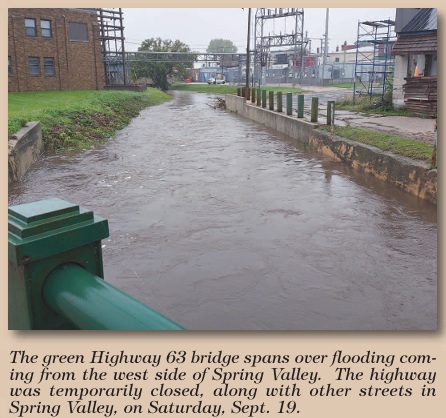
Spring Valley Public Library hosting another library

03/10/2026 by Chris Hahn

Original article published in the Mower County Independent, Thursday, March 5, 2026.   Reprinted with permission and gratitude.

By Gretchen Mensink Lovejoy


Magali Disdier Moulder’s mastering a library seeded with hope for great community. Oh, and squash, beans, peas, tomatoes, peppers, basil and quite a few flowers to check out.

“I contacted maybe a dozen seed companies, and three donated leftover seeds from last year,” said the Fillmore County Master Gardener, elaborating, “Together with the Spring Val ley Garden Club and the Friends of the Spring Valley Public Library (SVPL), we are organizing for the first time a seed library. In brief, we obtain seed packets that were left un sold last year from the seed companies, and we redistribute them, free of charge, to people in the community.”

Disdier went on, “The Spring Valley library agreed for us to use their facility to house the display and the educational sessions we are organizing at the seed library’s launch on Saturday, March 14 at 10:00 a.m. – there are three sessions, with one on starting seeds ahead of time in the basement, so there will be an educational session on that day about starting seeds, and other educational sessions will be on Tuesday, March 17 about straw bale gardening, and on Wednesday, March 18 about companion plants, both at 5:30 p.m. The Spring Valley Garden Club and the Friends have been wonderful in helping me in put ting together this seed library. People do not need to have a library card to pick seeds out of the seed library. They just need to leave a first name…I am interested in knowing how they heard from us, what interested them in it, what they’re picking, and what they want to see.”

What led to this project is that she is indeed a Master Gardener, someone so curious about how to grow things that she took official courses in gardening through the University of Minnesota Extension Service. “I think I like to grow things. It’s my favorite time of year for me, right at the beginning of spring when the first new leaves are on the trees and you can see the first shoots in the garden…that it’s growing, that it’s there,” she shared, going on to state, “I’m a newbie, really. I became a Mas ter Gardener about five to six years ago…I wanted to do it, and eventually, I jumped in and joined the group.” Fillmore County Extension Officer Katie (Winslow) Drewitz advises the gathering of approximately ten to a dozen Master Gardeners as they strive to learn more about germination, propagating plants, what soils are best for specific plants and what insects are beneficial, among the tenets of gaining knowledge on hearty gardening practices that produce things that are beautiful or good to eat. Disdier continued, “We’re a small group with such nice people. We’re supposed to bring education to the communities, and we’re here if people have questions.”

She determined that her mission as a university-educated gardener is to help others access the seeds that they need to actually start a garden of their own to enjoy the fruits – and vegetables – of their labor, so she decided to establish a seed library in collaboration with SVPL, thankful to the seed companies that donated everything from squash to flowers. “There are a lot of vegetables – beets, radishes, some spinach, peas, beans, squash, tomatoes, pep pers, we have some herbs such as basil. We have quite a few flowers as well, so I think there’s quite a range of seeds. I tried to make what I got into an assortment. I think the flowers will be popular, but I work in the hospital, and when people there ask me (about gardening), I tell them how to grow their own tomato seeds in their kitchen or their basement and see how much better their food is.”

As an immigrant to the United States, Disdier has gained knowledge of plants that she may not have otherwise encountered, making her own experience as a gardener somewhat parallel to that of others who are first venturing into the excitement of opening a seed packet, pouring soil into a pot or digging a hole in the ground and pushing seeds into the earth to see what comes of the effort. She observed that she entirely enjoys vegetables but had to figure out exactly what some were once she relocated across the miles. “I love fruits and vegetables, but some fruits are very strange, and a thing I didn’t know before I came to the States is okra. Now, I’ve learned to grow it and prepare it. We as Master Gardeners are a resource to the people in the community. If people have any questions, they can ask us, and if we don’t know something, we can try to find out, or they can contact the Extension office in Preston. But the library is open, and our seed library and sessions are completely free – they don’t have to pay anything for the seeds or to come to the seed library launch.”

She encouraged anyone who would like to grow a garden, be it in their kitchen or their yard, to take a moment to stop at the library during the seed library’s initiation. “We will keep the sessions to under 30 minutes, and maybe there will be time for questions afterwards if people want to ask. But I hope people come and join us.”

The Spring Valley Public Library, just off Broadway behind First National Bank, is open Monday from 10:00 a.m. to 6:00 p.m., Tuesday through Thursday from noon to 7:00 p.m., Friday from 10:00 a.m. to 5:00 p.m., and Saturday from 10:00 a.m. to 2:00 p.m. For more information on the library and its services, stop in or call 507-346-2100.


Courtesy of the Mower County Independent, 135 E Main St. LeRoy, MN 55951, (507)-324-5325
Filed Under: Spring Valley EDA News

MN Dept of Agriculture. Farm to Food Security Grants Open- New state funded program helps Minnesotans access more local food

02/23/2026 by Chris Hahn

For Immediate Release

February 19, 2026

St. Paul, MN: The Minnesota Department of Agriculture (MDA) is now accepting applications for the Farm to Food Security Grant program. Established by the Minnesota Legislature in 2025, the program is modeled after the former federal Local Food Purchase Assistance Program and supports local farmers and producers by funding projects that purchase local food and distribute it to Minnesotans experiencing food insecurity.

Individuals, nonprofit organizations, for-profit businesses, Tribal governments, government entities, agricultural cooperatives, economic development organizations, and educational institutions are eligible to apply. The program supports purchases of Minnesota-grown and -raised foods including produce, meats, and other whole, minimally processed, and processed foods with at least one primary ingredient that is 80% grown or raised in Minnesota. Grant funds may only be used for food distributions that take place in Minnesota.

“This program connects Minnesota grown food with people who need it, while helping small farmers build new markets and stable income,” said MDA Commissioner Thom Petersen. “We modeled it after a federal program that demonstrated real impact, and I appreciate the bipartisan work at the Legislature that made this program possible in Minnesota.”

The MDA may award up to $1.3 million in total funding for this program through a competitive review process. Applicants may request between $20,000 and $100,000, with a dollar-for-dollar match required on all funds over $50,000. This is a reimbursement grant, meaning awardees will need to pay for the project costs first, then submit receipts after the contract is signed in order to receive reimbursement.

Full grant eligibility requirements and application details are available on the MDA’s Farm to Food Security webpage. Applications are due by 4 p.m. on Tuesday, March 31, 2026.

Learn more about this program here –> Farm to Food Security Grant Program | Minnesota Department of Agriculture

Find out if your project is a good fit this grant here –> Spring Valley EDA Grant Qualification Checklist.

Filed Under: Spring Valley EDA News

First Children’s Finance MN announces numerous online, no-cost professional development and training opportunities

02/09/2026 by Chris Hahn

For Immediate Release


Image Courtesy of First Children’s Finance

First Children’s Finance MN is excited to announce numerous online, no-cost professional development and training opportunities for Minnesota providers in Spring 2026. These courses will help give providers the knowledge, resources, and connections to succeed in the child care industry.

 Click here to view the complete list of training opportunities and registration information for Minnesota Child Care Providers this spring! 


Filed Under: Spring Valley EDA News

Kiwanis honors Hailee Warren

02/05/2026 by Chris Hahn

Original article published in the Mower County Independent, Thursday, January 29, 2026.   Reprinted with permission and gratitude.

By Gretchen Mensink-Lovejoy


The Spring Valley Kiwanis Club has recognized Hailee Warren as one of this year’s Kiwanis Academic Excellence Award recipients. She is the daughter of Rick and Julee Warren. The Kingsland senior is active in several extracurricular activities. “I am football manager, I’m in basketball, softball, Student Council, Key Club, FFA and National Honor Society. I like basketball the best. In the past, I’ve been in all of these and volleyball, cross country and track. My favorite subject is calculus, and my least favorite subject is English.”

Outside of school, she’s awaiting summertime so that she can get back to work. “I work at the Spring Valley pool as a lifeguard and water safety instructor. I like teaching kids how to swim. In my spare time, I hang out with friends and go shopping. My favorite movie is ‘Stepbrothers’ because it’s funny, and my favorite book is ‘The Last Thing

He Told Me’because I like mysteries. My biggest pet peeve is when people chew with their mouths open.” She listens to ‘everything’ in music, but she prefers pop rock and ‘80s tunes most, and she’s an adventurous traveler who went to Peru last summer. “I love sushi, but I tried guinea pig in Peru, and it was terrible. If I could travel to any country in the world, I would go to Italy or Greece. There is a lot to see and do there. If I could travel to any state, I’d live in South Carolina…they don’t get snow.”

The 17-year-old most admires her parents and grandparents. “They are hardworking and taught me many life lessons. If I could do one thing to change the world, I would make volunteering a graduation requirement. When I was younger, I wanted to be a trauma surgeon, but after I graduate, I want to be a dentist.”

The Kiwanis honored Hailee and her parents during a luncheon meeting earlier this winter. The club welcomes visitors who are interested in learning more about Kiwanis International to its weekly meetings held at noon on Wednesdays at the Spring Valley Community Center.


Courtesy of the Mower County Independent, 135 E Main St. LeRoy, MN 55951, (507)-324-5325
 

Filed Under: Spring Valley EDA News

SMIF “Paint the Town Grant” Now Accepting Applications

02/03/2026 by Chris Hahn

FOR IMMEDIATE RELEASE

Image Credit: Southern Minnesota Initiative Foundation

OWATONNA, Minn., February 3, 2026 – Southern Minnesota Initiative Foundation (SMIF) is currently accepting applications for free paint and coating products for community mural, community welcome sign, historic structure or public art projects or to refresh public spaces in preparation for significant community milestone celebrations through its Paint the Town Grant program. This year, projects that lift up marginalized community members will be prioritized and the grant is open to all communities within SMIF’s 20-county region.

SMIF’s Paint the Town Grant Program is designed to build community collaboration with a unique and hands-on approach. SMIF donates up to 100 gallons of paint per project, with the goal of fostering inclusion through volunteer engagement, promotion of creativity, celebration of local pride and to enhance the beauty and interest of a space through community collaboration.

Public art projects include creative placemaking initiatives which incorporate the arts to create a place-based asset in a community. Examples may include painting a piano on a public, outdoor staircase, painting board games on public picnic tables, painting a pop-up park in an alleyway downtown or using paint on temporary or permanent art installations that enhance the vibrancy of a community.

“More than just beautifying, our Paint the Town Grant encourages communities to collaborate toward a shared vision of what they want their community to represent, remember and celebrate about themselves,” said Benya Kraus, SMIF president and CEO. “This kind of collaboration helps people take pride in where they live and unlocks creativity for what’s possible when we come together.”

To be eligible, organizations must be tax exempt 501(c)(3) organizations, units/agencies of local, state, or federal government and public schools/higher education institutions within SMIF’s region. All projects must demonstrate visual impact and be accessible to the public.

Since 1997, SMIF has distributed more than 11,314 gallons of paint to 337 projects in southern Minnesota through various programs. The Paint the Town Grant program was officially launched in 2015.

Applications are due to SMIF by March 3, 2026. For more information about the grant, and to see examples of public art and creative placemaking projects, visit smifoundation.org/paint. For questions regarding the application, contact Sarah Scheffert, communications and community vitality specialist, at sarahs@smifoundation.org or 507-214-7015.

CLICK HERE – To Learn about this Program

CLICK HERE – See if this is a good fit for your project


Filed Under: Spring Valley EDA News

Next Page »

Before Footer

Footer

Chris Hahn
Spring Valley EDA Director
Phone: 612-327-9729
Email: director@springvalleyeda.org

  • Business in Spring Valley
  • Spring Valley Business Directory
  • Business Real Estate
    (Sale, Lease, Rent)
  • Move to Spring Valley
  • Build in Spring Valley
  • Calendar
  • News & Information
  • Contact
  • City of Spring Valley
  • Spring Valley Chamber of Commerce
  • Home
SPRING VALLEY WEATHER

Copyright © 2026 · Website Design and Hosting by SMG Web Design | Preston, MN